


I got a chance to chat with Gaurav Vohra about executive communication. Gaurav built Superhuman from inception to exit, and now advises companies including Clay and Replit, and recently wrote about a concept I have been using in my own executive communication trainings but did not have the right word for it.
Altitude
In my usual manner, I asked those listening a question
When you’re giving an update to an executive, what’s hardest?
A. Knowing what level of detail they want
B. Getting to the point without losing important context
C. Making the “so what?” clear
D. Knowing what recommendation to make
The majority landed on B:
Getting to the point without losing the important context
This resonated with me, as I usually coach,
“be brief, be gone”
That is still true, but in our aspiration for less, we often forget that context matters. The uplevel is to
“get to the direction within your audience's context”
That is the difference between just short and short AND impactful.
Fall Course Calendar:
AI-Powered Executive Communication:
(Sept 16-24, Oct 21-29, Self-Paced)
Influence your internal conversations and represent your company. Build you AI communication system, get out of the copy and paste, and get the context fast to influence decisions.
Executive Product Leadership for Senior PMs and Directors(Sept 18-25, Nov 3-12)
GTM, financial fluency, executive presence, influence so you can run the business rather than just ship features another words become strategic.Command Presence Under Pressure (Oct 9th 9-12PST)
3 hour live workshop. The science around why you freeze in hard conversations, then 2 hours of hot-seat practice and group coaching.Answer Hard Executive Questions w/ Ravi Mehta (Free)
Sept 24, 11:30am PT / 2:30pm ET · 45 min
Learn why pressure makes you ramble, defend, concede, or freeze; and practice short responses that keep you steady and credible.
Highlights from our conversation
The Map
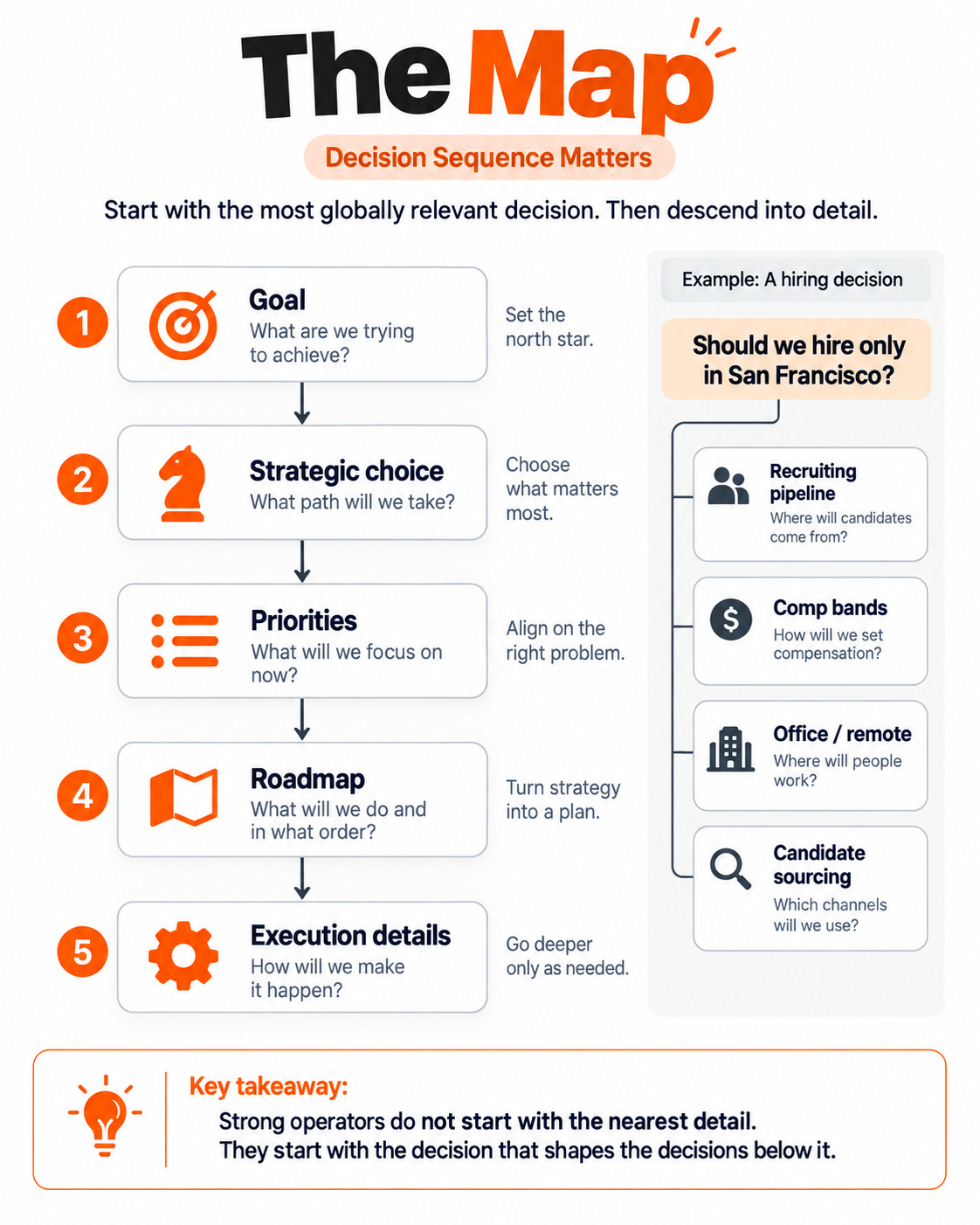
Gaurav described the strongest operators he works with as people who think about the problem at the most globally relevant level.
Once everyone agrees that they are discussing the right problem, they can descend into the details needed to solve it.
He calls the mental model underneath this
the map
The map shows how decisions fit together. Some decisions matter more because they completely subsume other decisions. Thus the sequence matters.
Gaurav gave a painfully familiar example.
Imagine your team spends hours debating how to hire more engineers in San Francisco. Recruiters. Compensation. Sourcing. Office space. Candidate pipelines. Except there is a higher-altitude question sitting above all of it:
“Should we even be hiring exclusively in San Francisco?”
If the answer is no, the discussion is irrelevant. You can give hours back to yourself and your team.
The same thing happens when you pick apart a marketing expense before agreeing on the marketing budget, or debate a roadmap feature when the team has not aligned on the outcome.
People can sound junior, even when their analysis is sound, because they are answering a question that does not matter.
Things you can try before your next executive update:
What decision are we making today?
Is there a decision one level above this that would make this discussion irrelevant?
What business outcome or constraint makes this worth attention?
Why now?
Build a theory of mind
The second concept Gaurav raised was
theory of mind
Strong operators develop a model of what everyone else knows. I talk about coherence here, which extends the theory of mind from people to system design. Similarly, I teach influence networks to build this system for yourself in Executive Skills.
Coffee chats and networking are used to build trust and relationships. Both are critical. The additional piece is mapping the other person’s context and context gaps.
Gaurav described strong PMs as people who continuously ask themselves:
“Does this person know this?”
And sometimes they literally ask:
“Do you already know about this? If so, I’ll skip over it.”
The junior behavior is assuming everyone is where you are, or assuming everyone has the same context as the person you work with most. The a$$hole behavior is assuming that you are the smartest person in the room and no one knows anything. So it is a delicate balance.
Tips for a quick audience check:
What do they already know?
What do they care about?
What decision are they expecting to make?
What context do I have that they do not?
What context do they have that I do not?
If you want to learn more about how to get a sense of what the people in the room know about, and more importantly care about, I give you additional tools in Master Executive Presence in Any Room.
High Altitude is not always the right altitude
Gaurav originally learned altitude as a management consultant trying to understand enormous companies as a 21-year-old analyst.
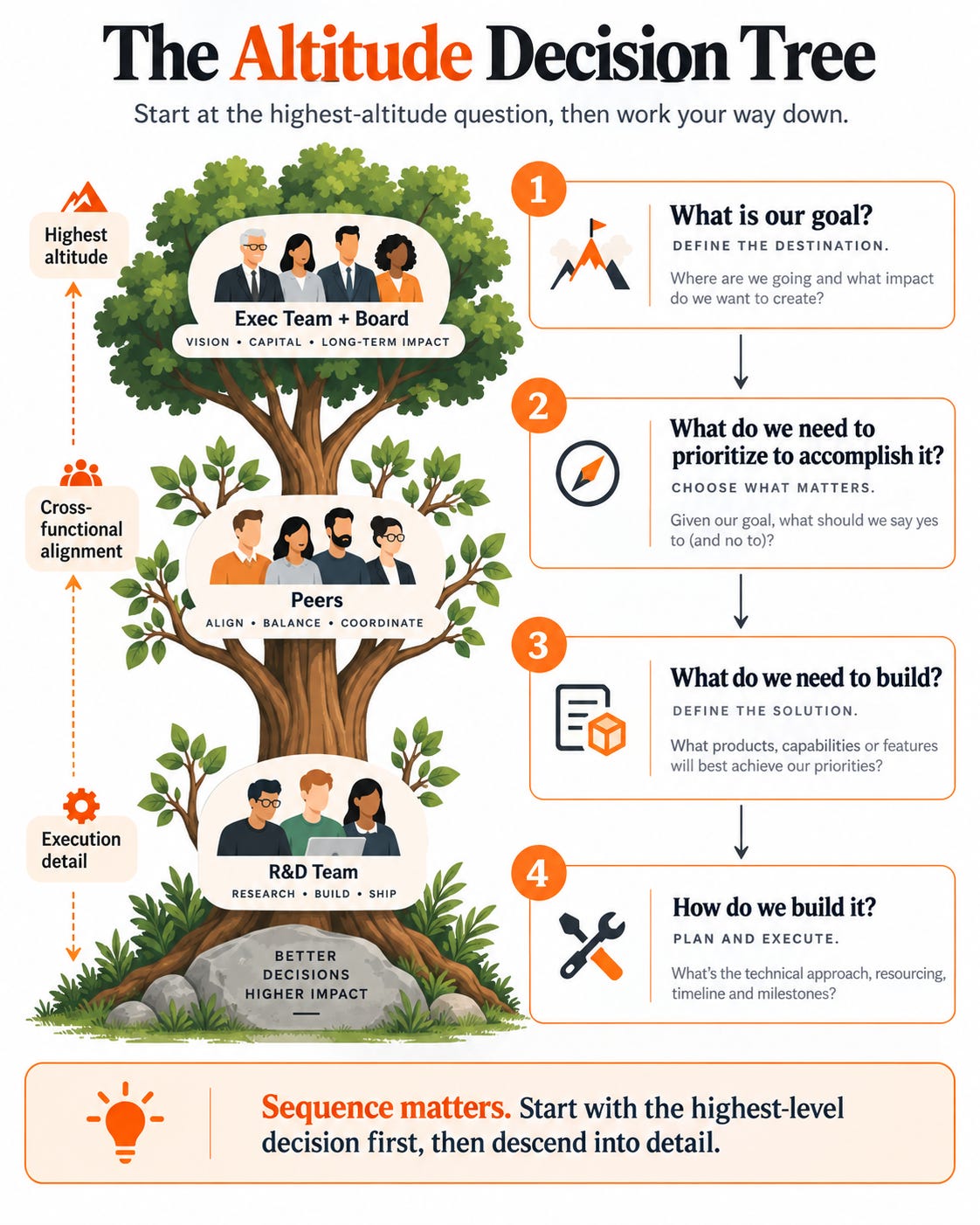
A senior partner taught him to think about decisions as a tree. Starting from the top and then working your way down through the questions
What is our goal?
What do we need to prioritize to accomplish it?
What do we need to build?
How do we build it?
As you start descending the decision tree, you might get into API design decisions or a specific line of code, but starting at the specific line of code does not get you back to the outcome. The important part is that higher altitude is not inherently better. That level sometimes gets you into existential wonderings rather than addressing the problem.
This became much more tangible for Gaurav at Superhuman.
He worked with a president named Paul who used altitude constantly in meetings. Most of the time, Paul would pull a conversation up.
But not always.
“80% of the time it was zooming out, but 20% of the time it was, we need to zoom the heck in right now.”
This connected to another phrase Gaurav used:
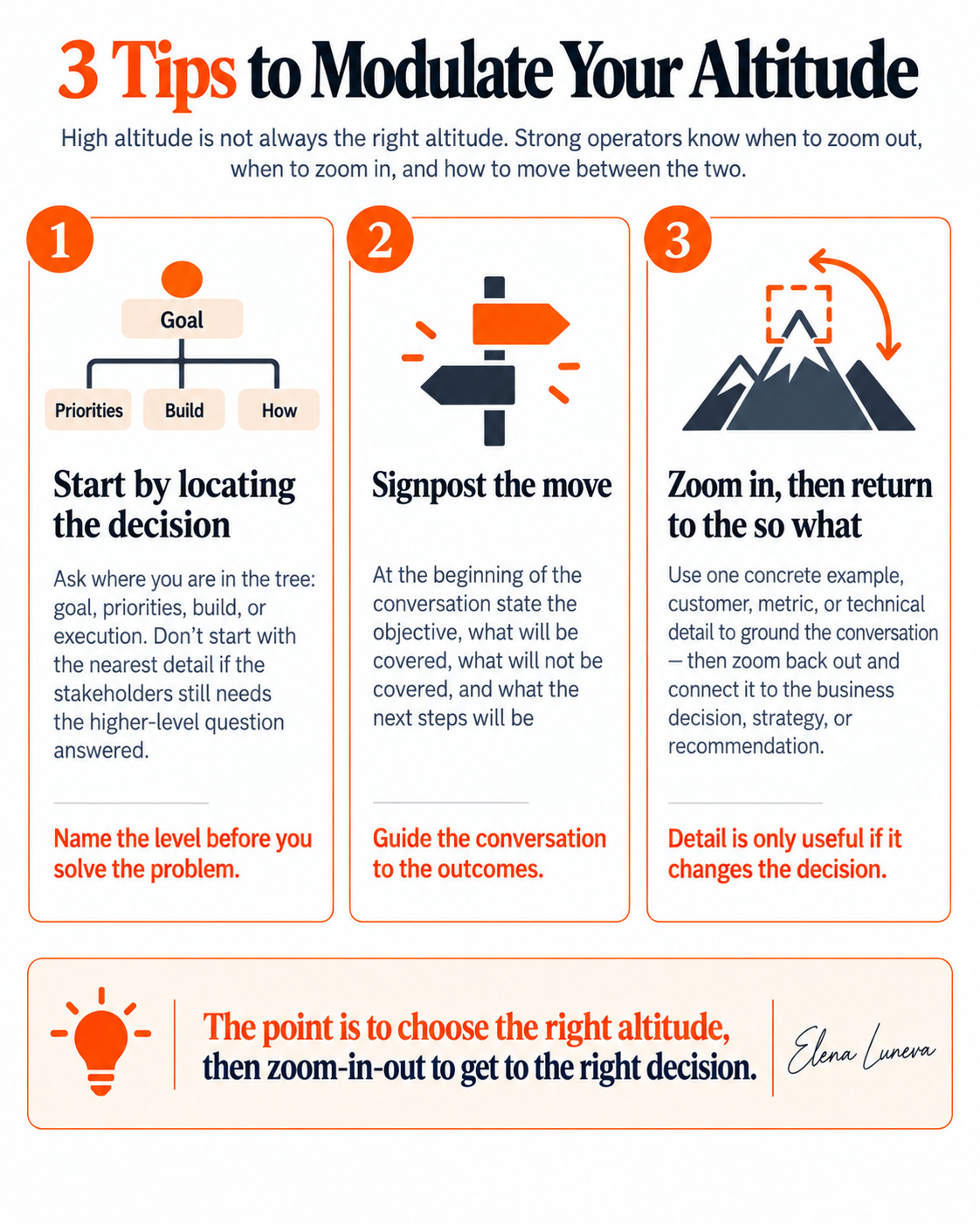
zoom in, zoom out
An analyst might zoom into one customer who represents an absurd portion of the company’s revenue. Understand exactly what is happening there. Then zoom back out to what that example means for product or business strategy, and the probability of replicating this.
The opportunity is to modulate your altitude and questioning to meet the context you are in.
Signpost to guide your audience
One of my favorite stories was actually about something that did not work. I do think this is how we all learn that frameworks are tools in our toolbox and must be applied contextually. The Superhuman executive team created a shorthand:
Altitude check
Anyone could say it during an executive meeting if they felt the discussion was getting too detailed. Which sounded useful and a direct application of the previous learning we just talked about. And yet apparently it was “atrocious”.
Gaurav said it just became “kind of a blunt object”. Someone would say “altitude check,” the presenter would get knocked off balance, and now they had to figure out what was wrong with the conversation without being told where it should go. Passive-aggressive, if you ask me.
What he realized was missing was signposting.
Instead of:
“Wrong altitude.”
Try:
“I’d like to zoom us out for a moment because there’s a question on my mind.”
Or:
“Can we zoom into that for a second? I think there’s a detail here that changes the answer.”
You are not criticizing the person speaking or throwing them off balance. You are orienting the conversation. The change feels small, but it has worked for me when teaching too.
In the first iteration of AI-Powered Executive Communication last January, we went on many tangents because the topic and application are so broad. So much so that I gave some students a lot of value, and the others, who were looking for the syllabus as promised, not as much. They told me so.
I adjusted the second iteration by adding signposting. I told the students exactly where we are, where we’re going, and what’s next. This helped us stay on track and define when it is time for questions and when it isn’t. This gave all the students the value as promised, and the reviews reflected it.
Recurring meetings need an altitude
Our calendar is littered with recurring meetings. Those meetings need an altitude too, so you can select which you should be in, and which you shouldn’t, and clean up your calendar garbage.
At Superhuman, Gaurav said the monthly business review had a threshold. If an item was not worth roughly $100K or wasn’t a metric they cared about, it did not belong. That did not make a $10K issue unimportant; it just meant there was a different forum for it. This altitude context setting helps the presenter understand what altitude to present at too.
Look at your recurring meetings and define what belongs there.
What size decision?
What time horizon?
What level of risk?
What magnitude of business impact?
And perhaps more importantly: what does not belong there?
You may also discover a few meetings you do not need to attend anymore, and give time back to people who do not need to be there either.
Brevity vs. compression
We ran out of time before I got to one of the questions I really wanted to ask Gaurav:
What is the difference between brevity and compression? So here is my take:
Brevity removes words.
Compression preserves the important information while removing everything that does not serve the decision.
Altitude is the first priority, making sure you are discussing the right problem at the right time by knowing the audience you are speaking with. Compression then surfaces the right information to this audience and removes the rest.
AI is making the information problem worse
There was an interesting tension in this whole conversation. Building the map requires paying attention.
Gaurav said the operators who are exceptional at this absorb an enormous amount asynchronously. They read the CEO update. They notice the Notion page changed. They follow what is happening around the business instead of only consuming information directly related to their task.
Then I pointed out the obvious problem.
Slack!
Slack started as a promise to take us out of email. It also took us out of the need to think before sending an email. And now we are in both. Plus, people have gotten great at using AI to create documents, status updates, you name it. It took me back to when my manager “learned” to use AI and just sent me 50-page unedited AI slop and called it “research”, expecting me to read what he clearly did not. So there are just more summaries of docs that people never read in the first place, sent to people who will not read them. But in all of this, there are nuggets! Alerts telling you your website is down. Threads from the consigliere to the CEO that just raised a half-baked thought that will change the direction of the company. How in the world are you expected to find them?
We have supercharged our ability to produce information much faster than our ability to consume it and connect the dots.
This is where I find AI much more useful as a listener than a writer.
For example, I use Cowork to create an influence net around the people and information I need to follow: my boss, my immediate stakeholder circle, my team, important bugs or incidents, plus the occasional unofficial person in the company who mysteriously seems to make everything happen.
Then instead of living in Slack, I can have my AI listener surface what changed, what I missed, what might affect my decisions, and send me back to the original thread when I actually need to engage.
The objective is not:
AI, write more updates for me. Which you can use it for.
It is:
AI, help me maintain the context I need so I can communicate the right thing at the right altitude to the right people.
This is a big part of what I teach in AI-Powered Executive Communication: how to build the communication system around you so you can spend time influencing people and developing strategy.
Audience Q&A
Kate: What if the information you need is not accessible?
Kate asked a question I think a lot of people experience:
What if you are not in the executive room? Important context is tribal knowledge. Decisions happen privately. You are expected to somehow know what you were never told.
Gaurav answered this at two levels.
At the company level, improve information access.
He told a great story about an intern named Tristan who joined Superhuman after working at Stripe. Tristan brought with him Stripe’s norm of transparent communication: if an email was not sensitive, copy an appropriate mailing list so other people could discover the information later.
The modern Slack equivalent is simple: stop having important non-sensitive discussions in DMs when they could happen in searchable public channels or async documents.
Tristan helped introduce those norms at Superhuman across email, Notion, and Slack. Sounds like Tristan also asked questions constantly.
By the end of roughly six months, Gaurav said Tristan had become one of the most knowledgeable people in the company, despite being an intern surrounded by people with many more years of experience and in the streams of a lot more information.
A few actions, depending on how much organizational power you have. Here is Gaurav’s take on Good Startup Communication.
Change the norm if you can. Move important information into accessible places.
Regardless of whether you can change your company’s communication system, ask more questions.
Pull up a chair where you can. Ask your manager to give you context from the meetings you are not in.
And use the information you do have — all-hands, financials, meeting transcripts, Slack, strategy docs — to build your own map instead of starting from zero every time.
Claire: How much detail creates credibility without opening the floodgates?
Gaurav’s answer started with identifying the conversation you are having. Is this conversation to inform, persuade, debate, or discuss? That changes the altitude and the people that you should be discussing with.
For genuine debate, you may need to stay deep much longer. The point of the conversation is to exchange information and arrive at a shared truth. Staying at 30,000 feet just means two people repeat their positions at each other without enough new information to make a decision.
Blake: What if reading all of this implicit context is harder for you?
As a neurodivergent person I experience much of this intuitively and psychically as an outsider, any recommendations on navigating this in a sea of subconscious bias, unspoken gating, how do you penetrate these channels?
We didn’t get to Blake’s question live, so this is my attempt.
The equalizing part is that this navigation is hard for everyone, but differently. User empathy is what remains consistent. Understanding the other person, their feelings and context, so you can communicate within their frame, biases, shorthands, and all. If you’re not sure, try replaying: “What I am hearing is X. Is that what you meant?”
Thanks for getting this far, and if you have techniques to get to the right altitude of the conversation, please share in the comments. I am always learning!
Thanks so much for having me! One of my favourite topics, glad we got to explore it.